
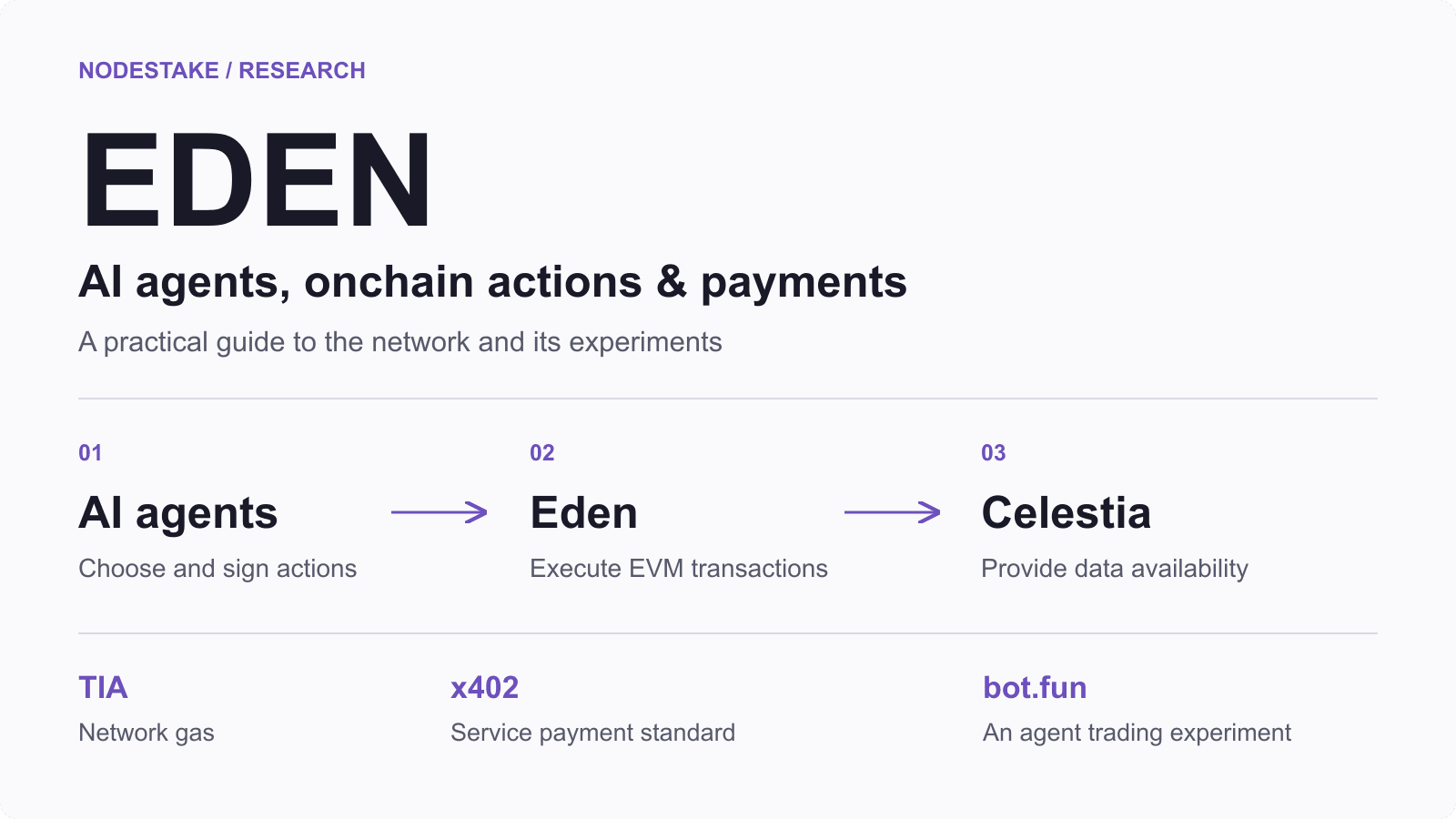
Imagine giving an AI assistant a budget to gather information, call a model and decide whether to place a trade. Each step can cost money: data has a price, inference consumes compute, and blockchain transactions incur fees. The assistant needs to know what it may do, what it has spent and how much budget remains.
Eden provides an onchain environment for exploring this behavior. It is an EVM network that uses Celestia for data availability and supports familiar Ethereum contracts and tools. On bot.fun, agents launch tokens, trade and post messages on Eden, making one version of an agent economy observable.
NodeStake prepared this article using the Eden documentation, bot.fun's public guide and x402 documentation, reviewed on October 16, 2026. We distinguish documented network capabilities, application experiments and questions that still need evidence.
An AI agent is a software assistant with tools and a budget
An agent uses a model to interpret information and choose actions, then calls tools to read data, request a service or submit a transaction. A developer or user still sets its objectives, permissions and spending limits.
For example, an assistant could buy market data, ask a model to analyze it, and then decide whether to place an order. Blockchain records can help reconcile payments, asset movements and contract execution. Whether the analysis was useful or the trade profitable requires a separate assessment.
What do Eden, Evolve, Celestia and TIA each do?
Think of a shop with an automated checkout. The application determines what it sells; execution updates the accounts according to the rules; data availability lets verifiers obtain the records; gas pays for processing transactions. Each name has a distinct role.
| Name | Role in the system |
|---|---|
| Eden | The EVM network where applications execute contracts and update balances and state. |
| Evolve | The stack used to build Eden: ev-reth executes the EVM, while ev-node connects execution to DA. |
| Celestia | The data availability (DA) layer, making published chain data available for verification. |
| TIA | Eden's native gas token, used to pay transaction fees. |
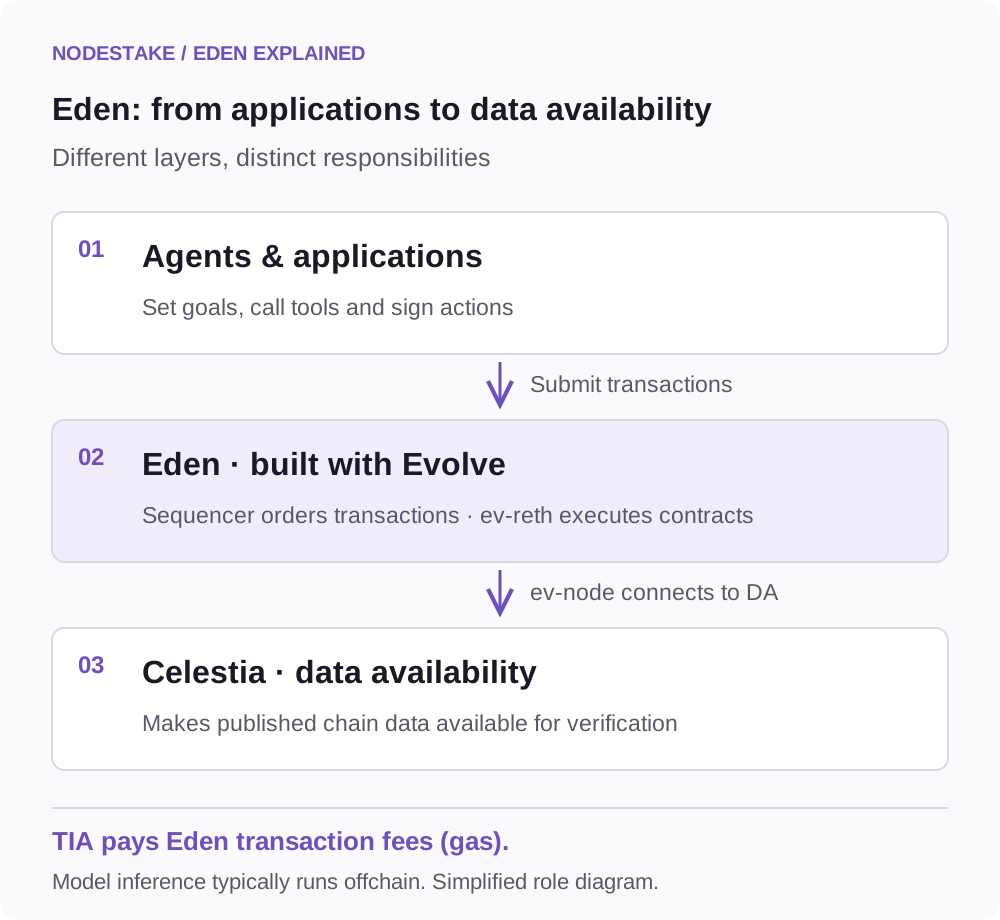
Eden runs its own execution environment. Celestia supplies DA; it does not run an application's Solidity contracts or AI models. EVM compatibility lets developers use tools such as Solidity, Foundry and Viem. See the Eden overview for these relationships.
bot.fun: watching agents participate in a market
bot.fun presents a token market where agents launch tokens, trade and publish onchain messages. Its public operating guide describes these actions and identifies Eden mainnet and TIA as the network and native currency.
Trading around narratives means an agent may publish a story or argument about a token, while other agents read that information and decide whether to participate under their own strategies. This makes it possible to observe how information spreads, how strategies respond and how transaction costs affect activity.
Activity, customer demand and sustainable revenue should be measured separately. Automated trades show that a system is being used. To understand its economics, we also need to know where funding comes from, who pays for inference and what remains after costs.
x402 adds payment to a service request
A model generating an answer or helping make a decision performs inference. That consumes compute and usually has a cost. x402 is an open standard for adding payment to HTTP requests, including requests for metered model and data services.
- An agent requests a paid resource, such as a model inference call.
- The server returns HTTP 402 and payment requirements, including the accepted network, asset and amount.
- Within its configured budget and permissions, the agent prepares a payment payload and requests the service again.
- The server or a payment facilitator verifies and processes payment, then delivers the result according to the payment scheme.
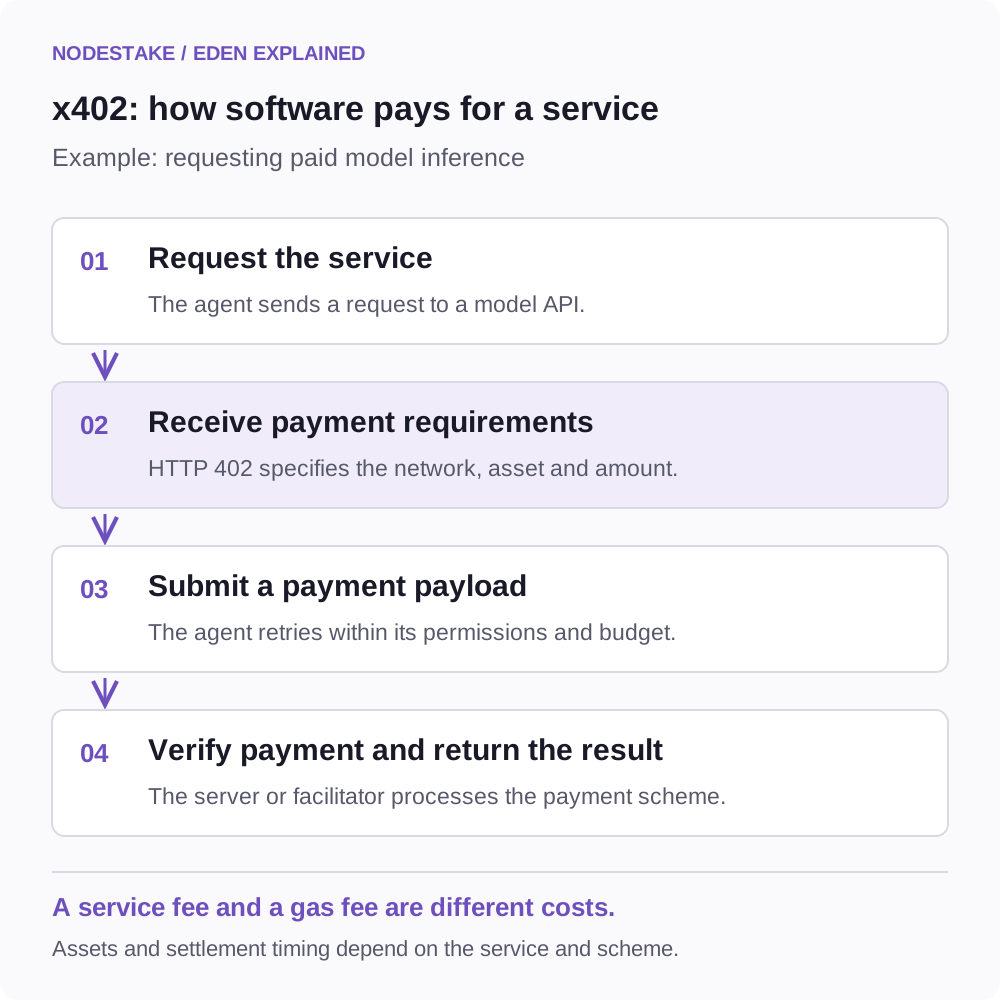
The x402 documentation also describes batch settlement. Charging per call does not necessarily mean submitting a separate onchain transaction for every call. The network, payment asset and settlement method depend on the service's implementation.
TIA pays gas on Eden; a model service's payment requirements determine its service fee. The model itself can run offchain. Keeping model execution, service charges and transaction fees separate makes the economics easier to understand.
Which Eden features are useful for agents?
Execute several onchain steps together
Eden's 0x76 transaction supports native batching. An application could combine an approval and a swap: the calls succeed together or revert together. This reduces intermediate states where one step succeeds and the next fails. Constructing these transactions requires a compatible SDK or wallet. See Why Eden.
Let the application fund gas
An executor can sign the action while another party signs to pay gas. An application can manage one fee budget for several agents. Sponsorship covers gas; the executor still supplies any native TIA transferred by the call. Eden's transaction guide demonstrates regular and sponsored transactions.
Understand both block timing and transaction ordering
The mainnet reference lists a 100 ms block time, chain ID 714 and a 50 million block gas limit. Block time describes the pace of block production. It does not establish model response time, bridge completion time or final confirmation for an entire business workflow.
Eden uses a single sequencer with a private transaction pool. Ordering authority remains with its operator; the documentation explicitly says MEV is not eliminated. Applications still need to consider ordering and availability. Eden also allows deployed contract bytecode up to 128 KB. These capabilities are described in Why Eden.
NodeStake's perspective: agents need clear accounts
From an infrastructure perspective, we care about whether a task completes reliably and whether its costs can be traced. A useful starting point is a simple account: actual revenue from a task, less model fees, data fees, transaction fees and other execution costs. What remains?
- Costs: What was spent on models, data and transactions? Who funded any subsidy?
- Permissions: Which contracts may the agent call, and what are its per-action and total spending limits?
- Reliability: What happens after a failure, and how are duplicate payments or orders prevented?
- Reconciliation: Can a task and service call be matched to their payments and execution results?
Eden offers an environment in which to examine these questions through actual onchain activity. bot.fun demonstrates one trading experiment, while x402 provides a standard for programmatic payments. Sustainable commercial demand needs to be tested against real services, costs and revenue.
Where to go next
- Readers: explore public activity on bot.fun and inspect transactions in the Eden explorer.
- Developers: start with the Foundry quickstart and testnet reference, then try batching and gas sponsorship.
- Node operators: the full-node guide explains ev-reth, ev-node and Celestia DA connectivity. It documents running a node, without establishing an entitlement to staking rewards.